Phase 1
52,000–62,000 lb/yr (66,000 lb upper-bound)
- Boxes
- 20
- Footprint
- ~30,000 sq ft
- Channel focus
- Live HOSO restaurants + Asian retail live tanks + DTC
Product & operations
Modular, sensor-driven, antibiotic-free. Twenty tanks in roughly thirty thousand square feet. Eight kilometres to the Costco Langley depot. Year-round production. Same-day live harvest to the Vancouver core.
How it works
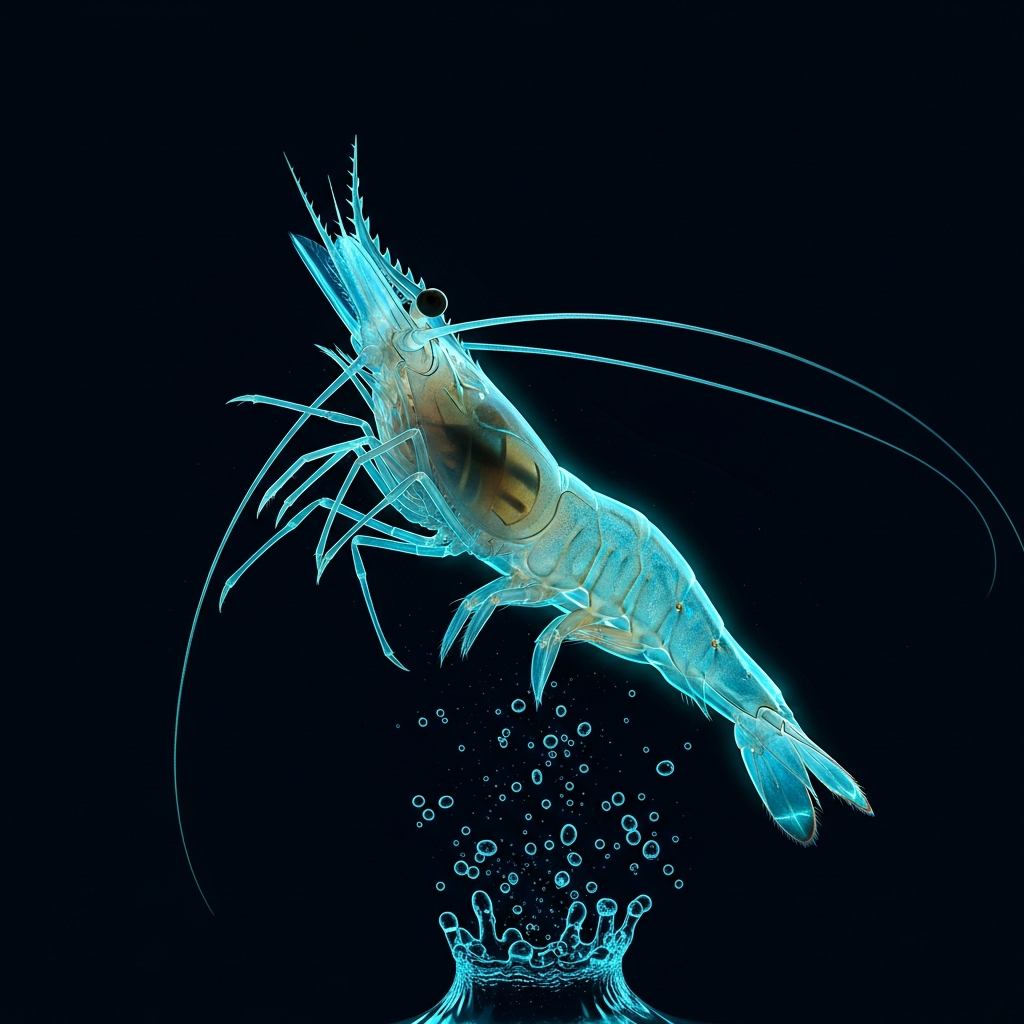
We grow shrimp in clean tanks inside a building in Langley, BC. The shrimp never touch the ocean and the ocean never touches the shrimp.
Each tank uses tiny helpful microbes — we call this a — that eat what the shrimp don't eat. The microbes keep the water clean, and we never use antibiotics.
Sensors watch the water 24 hours a day, every day. They check the temperature, the oxygen the shrimp breathe, how salty the water is, and a few other numbers. If anything looks wrong, a person finds out right away.
The shrimp grow for about four months. When they are ready, we lift them out, chill them down very fast so they stay perfectly fresh, weigh them, pack them, and put them on a truck. The truck drives them to a Vancouver restaurant or a grocery store.
Because the shrimp lived their whole life in our tank, we know exactly what they ate and exactly when they were caught. We can print that story on a little card that comes with every bag.
Grow cycle
16 weeks per tank
Per box, per year
52–62K lb/yr at 20 boxes (verified spec)
To the Vancouver core
Shorter than the drive to Whistler
Operations
Hover any underlined term for a one-sentence definition. Every number on this page traces to the cross-discipline review docs (CTO §3 and §6, COO §3 and §4, Regulatory §3).
Phase 1
Phase 2
~1,150 sq ft per box (CTO §1)
~50–60 lb/wk/box vendor spec (Atarraya published)
4-week operator training in Indianapolis included in the licence
Status: under negotiation. Target close OPS-05 Day +90 from kickoff. Each ask has a documented walk-away trigger in the CTO playbook (§3); without all five, the licence does not sign.
ASK-1
Atarraya raised $5M Aug 2025 against a $20–25M Series B that has not publicly closed; escrow ensures continuity if Atarraya ceases support over our 5–10 year operating partnership.
Walk-away. Atarraya refuses any third-party escrow, or insists on Atarraya-controlled "escrow" that is functionally a marketing document.
ASK-2
North 49 will develop IP around BC water chemistry, cold-climate energy modulation, and biofloc microbial-consortium tuning at 49°N. That IP must remain North 49’s to preserve Phase 2 self-build optionality.
Walk-away. Atarraya demands assignment, exclusive licence in Canada, or any structure that lets Atarraya productize North 49 cold-climate IP back into the Canadian market.
ASK-3
Royalty drag at flat 8% is $237K/yr at Phase 2 revenue; step-down to 5% at 50 boxes and 3% at 100 boxes is the difference between a bankable Phase 2 case and one that does not exist.
Walk-away. Atarraya refuses any step-down and insists on flat 8%. If royalty cannot move and software cannot be unbundled from hardware, walk entirely (Pivot 5).
ASK-4
Deal-breaker. Cloud outage > 4–8 h or Atarraya company shutdown equals mass mortality. Local mode lets each box hold a known-good water-chemistry envelope autonomously while we investigate.
Walk-away. Atarraya refuses local-mode firmware. Per cross-module risk register Pivot 5: walk away from Atarraya entirely and pursue self-built biofloc containers + a non-Atarraya control stack.
ASK-5
KILL-1 gate. Without a CFIA Form 5670 path naming American Penaeid (Pine Island FL) (primary) and a Mexican alternate, North 49 cannot legally stock — and any Atarraya hardware order becomes inventory-without-broodstock.
Walk-away. CFIA returns a negative pre-clearance and no alternate hatchery is qualifiable within 90 days. Per KILL-1, the venture stops or pivots site; the Atarraya MLA does not get signed.
Per-tank sensor channels sampled at 1 Hz. 1-minute aggregations persisted on the ; 5-minute aggregations persisted to cloud. Operator-controlled edge gateway provides a second layer of resilience on top of the Atarraya (72+ hour autonomous operation if cloud is unreachable).
| Parameter | Technique | Precision | Envelope (HACCP CCP-2) |
|---|---|---|---|
| Dual-redundant optical DO probes | ±0.1 mg/L | DO ≥5 mg/L | |
| Temperature | RTD (Resistance Temperature Detector) | ±0.1 °C | 28–30 °C |
| pH | ISFET (Ion-Sensitive Field-Effect Transistor) | ±0.05 pH | pH 7.6–8.2 |
| Inductive conductivity | ±0.5 ppt | 15–30 ppt | |
| Colorimetric or ion-selective electrode | ±0.1 mg/L | TAN <1.5 mg/L; NO2 <5 mg/L | |
| Alkalinity | Titrimetric weekly + continuous indirect (pH/conductivity) | Weekly grab + 1 Hz indirect | Buffered for biofloc activity |
| Total suspended solids | Turbidity + Imhoff cone reference | Continuous + weekly verification | TSS 200–500 mg/L (biofloc volume) |
| Flow + level | Paddlewheel + ultrasonic | Per-loop | Per-box recirculation rate |
Cloud SCADA uptime target: 99.5% monthly
Sensor channel availability: 99.9% per tank monthly
Traceability platform availability: 99.5% with ≤4 h recall query response for ≥99% of any single lot
Every consumer pack carries a 2D barcode resolving to the lot card: source and PCR-clear status, stocking date, culture-cycle water-quality summary, feed lot, harvest day, IQF lot, and processing room. The buyer-facing dashboard ships Month 6 for chef + Costco-buyer views.
ThisFish / Tally
Primary system of record — GDST-aligned. PL lot → stocking → cycle → harvest → processing batch → EDI 856 ASN.
Phase 1 — Month 6 target
Trace Register
EDI 856 bridge to the Costco vendor network.
Phase 2 — added on Costco onboarding
SPS Commerce
EDI integrator into the Costco Value-Added Network.
Phase 2 — concurrent with Trace Register
Buyer-facing dashboard
Per-pack QR codes resolving to a lot card: PL source, water-quality at culture, harvest day, processing chain.
Month 6 target — chef + Costco buyer views
Lot-code schema: DEEN-YYYYMMDD-CC-HH-PB-BB (site · date · cycle · harvest · processing batch · case). -interoperable export feed; as primary traceability; as Phase 2 856 ASN bridge to .
Twelve nodes from inbound through outbound logistics. Three remaining red single-points-of-failure are flagged below with their close paths.
N1
PL hatchery
N2
Air-freight PL transport
N3
On-site quarantine raceway
N4
Feed
N5
Probiotics, salts, treatment
N6
Packaging
N7
Grow-out (20 Atarraya boxes)
N8
Harvest + ice slurry pull-down
N9
Live transport (restaurants + Asian retail)
N10
Toll processing (frozen / IQF / HLSO / P&D)
N11
Frozen storage (post-IQF)
N12
Outbound reefer LTL
Heat load lives on natural-gas radiant (8–15× cheaper per kWh-equivalent than electric resistance). Electric service from covers pumps, blowers, lighting, and instrumentation only. The licensed mech-eng heat-load + electrical-load study (V-01) closes the $160–310K/yr OPEX gap surfaced by Module 05 against the founder's original 44,400 kWh/yr line.
Min
$131K/yr
Phase 1 annual energy
Phase 2 (~3.5×): $460K/yr
Expected
$177K/yr
Phase 1 annual energy
Phase 2 (~3.5×): $620K/yr
Max
$379K/yr
Phase 1 annual energy
Phase 2 (~3.5×): $1,170K/yr
Ten from PL receiving through trailer load-out under Part 4 + s.86–88 and a written . Live-product branch built in parallel covers transport oxygen, holding-tank water quality, and surveillance for the live HOSO and Asian retail tank channels.
Frozen + packaged product
PL receiving
AIRS pre-shipment + CFIA Form 5670 + PCR-screen clear for IHHNV/WSSV/EHP before stocking
Culture-water quality (continuous)
1 Hz monitoring of salinity, pH, temp, DO, TAN, NO2, alkalinity, TSS against envelope (CCP-2 the largest sensor surface)
Feed receiving
Lot-level COA on every Zeigler shipment; mycotoxin + antibiotic residue panel; quarantine pending clearance
Harvest pull-down
Core ≤4 °C within 60 minutes of harvest (chilled brine + ice slurry)
IQF / blast freezing (frozen channel)
Time-temperature integration through the IQF tunnel; toll-processor responsibility under co-mfr-of-record terms
Cold storage
Continuous temperature logging in 3PL freezer + at-processor; 24/7 alarm on excursion
Processing room sanitation
Environmental monitoring program for Listeria + Salmonella across food-contact and zone-3 surfaces
Packaging / labelling
Net-weight verification + allergen review + lot-code application per `DEEN-YYYYMMDD-CC-HH-PB-BB` schema
Pathogen testing per lot
Salmonella, V. parahaemolyticus, V. vulnificus, Listeria monocytogenes, E. coli, TPC, S. aureus by lot
Trailer load-out
Reefer pre-cool verification + seal log + EDI 856 ASN issuance against the lot at gate
Live-product branch (built parallel)
Live-transport oxygen + temperature
Oxygenated transport tank monitoring through last-mile delivery to restaurants and Asian retail live tanks
Holding-tank water quality
Continuous sonde on the holding tank at point-of-sale; salinity + DO + temp logged through to handoff
Vibrio surveillance cadence
V. parahaemolyticus + V. vulnificus sampling cadence specific to live-product handling, layered on top of CCP-9
BC Fish Inspection Act s.4 direct-sale carve-out
Documented direct-sale records for live-channel under BC fish inspection rules
Each tank is an independent containment cell with its own water, its own sensors, and its own failure mode. Twenty of them is not a farm. It is twenty farms sharing a roof.
| Layer | Contents |
|---|---|
| Inputs | Postlarvae; Feed; Marine water; Energy |
| Tank shell | Atarraya box outer wall; Sensor harness; PLC |
| Biofloc water column | Recirculating bioreactor; TSS-managed floc; Probiotic culture |
| Yield | Harvest output; ~3,300 lb / box / yr; 16-week cycle |
| Discharge & nutrient recovery | Treated wastewater; Nutrient recovery stream |
| Channel endpoints | Fresh-premium restaurant; Live HOSO restaurant (Day-1); Asian retail chain (T&T, H-Mart); Asian banquet — independent; Costco wholesale (Phase 2 cert-gated); DTC halo (3-6K lb/yr) — all PLAN status (none transacted at Phase 1). |
See /competitive for the conventional import chain comparison.
Schedule an operations call →Site selection
A leased ex-cannabis M-2 industrial bay in the Lower Mainland. $2.5–3.3M CAPEX + $700K working capital. Three–six months to operations, not eighteen-to-thirty. Three candidate sites under term-sheet collection.
Candidate A
Langley (Gloucester Industrial / 200 St corridor)
Candidate B
Abbotsford (Sumas Way / Riverside corridor)
Candidate C
Surrey (Campbell Heights business park)
All three require a licensed BC mech-eng heat-load + electrical study before LOI. Addresses are illustrative pending broker shortlist (OPS-01) and live MLS verification.
Open gates
Five gates remain open on the product side. Each has an owner and a target close date. We do not advance equipment commitments or claim certifications we have not earned.